Neonicotinoids are the most commonly used class of pesticides in the world protecting crops from insects but not without untoward side effects including killing beneficial insects that pollinate the crops we need. Additionally this class of pesticides has been show to have negative effects on songbirds in laboratory studies.1 Migrating songbirds frequently forage and ingest seeds treated with these pesticides during their migrations. Until now the effects of neonicotinoids on free living wild birds had not been studied.
As reported by Kristine Liao in Audubon:
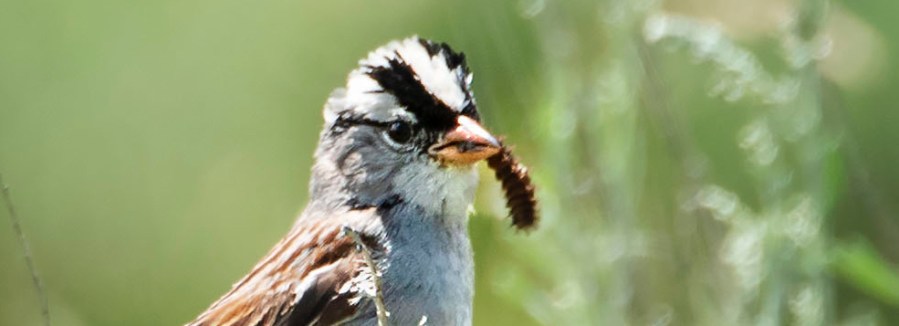
“A new study published online today in Science provides the first evidence that neonics harm songbird populations in the wild. University of Saskatchewan researchers found that White-crowned Sparrows that consumed small doses of a neonic called imidacloprid suffered rapid weight loss and delayed migration, both of which can hinder birds’ survival and ability to reproduce.”2
This is an interesting study where researches captured free-living White Crowned Sparrow and feed them them either a low dose, high dose pesticide or a control meal as well as fitting them with a tiny radio transmitter that allowed the freed birds to be tracked over a 100,000 square-kilometer area.
The sparrows fed the highest dose lost on average 6% of their body weight and 17% of their fat reserves both of which are vital for fueling successful migrations.3 Sparrows who consumed the pesticide then delayed their migration between 2-4 days compared to the control fed birds.
As for the potential consequences of songbirds delaying their migration in response to pesticide intake, one of the studies authors, Bridget Stuchbury,was quoted in a report by Smithsonian as saying:
“that extended rest stops can leave birds—already disoriented by the toxic chemical—vulnerable to predators. At the same time, she explains, late arrival to a final migration destination may reduce a bird’s chances of finding a mate, particularly if it has a shorter breeding season.”
Neonicotinoids are considered cheap insurance against insect-pests for many crops including corn, canola and soybeans and one of the most widely-applied pesticides in the world. The scientific evidence is now clear that these pesticides have harmful effects on bees, fish and now bird populations. How much more evidence will be required before we stop using these chemical willy-nilly… Before, or after, we loose innumerable bees, birds and fish?
References:
1. https://www.sciencemag.org/news/2019/09/common-pesticide-makes-migrating-birds-anorexic
2. https://www.audubon.org/news/a-widespread-pesticide-causes-weight-loss-and-delayed-migration-songbirds
3. A neonicotinoid insecticide reduces fueling and delays migration in songbirds. Margaret L. Eng, Bridget J. M. Stutchbury, Christy A. Morrissey, Science 13 Sep 2019:Vol. 365, Issue 6458, pp. 1177-1180. DOI: 10.1126/science.aaw9419










 nature has no boss
You must be logged in to post a comment.